<?xml version="1.0" encoding="UTF-8"?>
<!--Generated by Squarespace Site Server v5.11.81 (http://www.squarespace.com/) on Thu, 31 May 2012 04:26:54 GMT--><feed xmlns="http://www.w3.org/2005/Atom" xmlns:dc="http://purl.org/dc/elements/1.1/"><title>Venture Examiner</title><subtitle>Venture Examiner</subtitle><id>http://www.ventureexaminer.com/venture-examiner/</id><link rel="alternate" type="application/xhtml+xml" href="http://www.ventureexaminer.com/venture-examiner/"/><link rel="self" type="application/atom+xml" href="http://www.ventureexaminer.com/venture-examiner/atom.xml"/><updated>2012-04-26T05:12:34Z</updated><generator uri="http://www.squarespace.com/" version="Squarespace Site Server v5.11.81 (http://www.squarespace.com/)">Squarespace</generator><entry><title>South African Private Equity - Firms Listing as Holding Companies</title><category term="Africa"/><category term="Holding Company"/><category term="Listing"/><category term="Private Equity"/><category term="South Africa"/><id>http://www.ventureexaminer.com/venture-examiner/2012/4/25/south-african-private-equity-firms-listing-as-holding-compan.html</id><link rel="alternate" type="text/html" href="http://www.ventureexaminer.com/venture-examiner/2012/4/25/south-african-private-equity-firms-listing-as-holding-compan.html"/><author><name>AV</name></author><published>2012-04-26T04:59:03Z</published><updated>2012-04-26T04:59:03Z</updated><content type="html" xml:lang="en-US"><![CDATA[<p style="text-align: center;"><span class="full-image-block ssNonEditable"><span>&nbsp;</span><img style="text-align: center; width: 500px;" src="http://www.ventureexaminer.com/storage/South%20Africa.jpg?__SQUARESPACE_CACHEVERSION=1335416932066" alt="" /></span></p>
<p style="text-align: justify;"><em>I recenlty returned from a trip to South Afirca where along with a team of students, I engaged in a study of the country's private euqity industry. My next few posts will be comprised of some interesting trends and data we picked up on while there. The first will be on the topic of private equity firms listing as holding companies:&nbsp;</em></p>
<p style="text-align: justify;">In mid-2011, Brait, the leading South African private equity firm, unveiled a change in business model so dramatic in its structure and scale that it was viewed by many as a seminal moment for the industry.&nbsp;&nbsp;The firm announced it was evolving its business model from being a manager of third party funds to becoming an investment holding company.&nbsp;&nbsp;Instead of only raising private capital from third party investors to fund its private equity investments, Brait would now also raise capital from time to time in the public equity capital markets and invest this capital directly into private equity deals.&nbsp;&nbsp;There had been speculation that Brait was struggling to raise capital from traditional limited partners and that perhaps the holding periods for its investments were longer than what investors were expecting.&nbsp;&nbsp;The new structure allows the firm to maintain the existing strengths of the private equity model while, for the first time, tapping into the strategic benefits of raising funds from the public equity markets.&nbsp;&nbsp;This means there is less pressure on exiting deals within certain timeframes.&nbsp;&nbsp;The move necessitates Brait&rsquo;s business model changing from a fund management business with annuity income streams (from fees and carry) to an investment business underpinned by the valuation of the underlying portfolio of its assets.&nbsp;&nbsp;As a result, the net asset value (NAV) of the firm&rsquo;s investments will be the most tangible means through which the firm&rsquo;s performance can be measured.&nbsp;&nbsp;</p>
<p style="text-align: justify;">Another example of a South African firm shifting to holding company status is Chayton Capital, a global firm with an African agriculture private equity investment arm based out of Cape Town.&nbsp;&nbsp;In early 2012, Chayton sold 81% of its agriculture private equity vehicle, Chayton Atlas Agricultural Company, to South Africa-based investment company Zeder for $46.7million.&nbsp;&nbsp;Much of the capital is set to be released in stages as needed to fund acquisitions across sub-Saharan Africa.&nbsp;&nbsp;Chayton&rsquo;s focus made it challenging to meet private equity investor&rsquo;s expectation of a typical five-year investment cycle.&nbsp;&nbsp;Similar to Brait (who invests across multiple sectors), raising capital became more difficult as a result.&nbsp;&nbsp;Holding company status affords firms like Chayton more flexibility with their investment model and can make raising capital easier.&nbsp;&nbsp;</p>
<p style="text-align: justify;">According to South African private equity professionals we met with, more and more firms will list this way in the future, in large part because there are fewer regulatory issues and the pool of available capital is larger.&nbsp;&nbsp;It may even be feasible for first-time managers in South Africa to raise capital via listing as a holding company, either public or private.&nbsp;&nbsp;If more firms choose to list as holding companies, the landscape of the South African private equity industry could be in for a major restructuring, making this trend well worth monitoring.&nbsp;</p>]]></content></entry><entry><title>Right Side Capital Management: A New Take on Angel Investing</title><category term="Angel"/><category term="Seed Stage"/><category term="Venture Capital"/><category term="investing"/><category term="start-ups"/><id>http://www.ventureexaminer.com/venture-examiner/2011/10/21/right-side-capital-management-a-new-take-on-angel-investing.html</id><link rel="alternate" type="text/html" href="http://www.ventureexaminer.com/venture-examiner/2011/10/21/right-side-capital-management-a-new-take-on-angel-investing.html"/><author><name>AV</name></author><published>2011-10-21T20:05:55Z</published><updated>2011-10-21T20:05:55Z</updated><content type="html" xml:lang="en-US"><![CDATA[<p style="text-align: center;"><span class="full-image-block ssNonEditable"><span><a href="http://www.rightsidecapital.com/home.html"><img src="http://www.ventureexaminer.com/storage/RSCM.jpg?__SQUARESPACE_CACHEVERSION=1319228007466" alt="" /></a></span></span></p>
<p style="text-align: justify;">Recently launched <a href="http://www.rightsidecapital.com/home.html">Right Side Capital Management</a> is taking an entirely new, and in some ways radical, approach to angel and seed investing. The firm is aiming to allow startups to simply apply online for funding and receive an instant valuation and investment terms &ndash; without any pitch or in-person meeting. Companies would be initially screened by their responses to a handful of questions on <a href="http://www.rightsidecapital.com/demoforms.html">two very simple forms</a>. One form simply asks for resume-related information about the startup&rsquo;s founders (things like education, management experience and technical expertise). The other form asks for information on the startup such as the industry, progress to date and financial information. Apparently the valuation algorithm they have developed will be able to provide &ldquo;accurate results&rdquo; for startups ranging from the idea to initial revenue stage that have raised less than $100,000 and are seeking a funding round of less than $500,000.</p>
<p style="text-align: justify;">After the short forms are complete, Right Side Capital will invite select teams to complete long versions of the forms and submit a business plan, budget and other documents. Right Side expects to fund 25 to 50 percent of companies that make it through this stage and receive funding. In total, the firm expects to fund &ldquo;hundreds&rdquo; of startups per year. &nbsp;After funding a company, Right Side acknowledges that it cannot provide intensive one-on-one support but will provide access to incubators and other angles. In the long-run it plans on establishing an internal advisory board of experts across operational and technical areas.</p>
<p style="text-align: justify;">Even though the firm is new, Right Side is clearly serious about early stage investing; in fact they were part of a syndicate that recently provided $24 million in funding to TechStars startups (alongside firms such as Foundry Group, RRE Ventures and SoftBank Capital). The firm&rsquo;s high-volume approach to vetting and investing in startups is definitely unique, especially for a firm that utilizes an otherwise traditional Limited Partner-backed fund structure. &nbsp;The jury is clearly still out on the model because it&rsquo;s so new and radical, but given what we know so far, I was able to see a number of positive and negatives as well. I also have some thoughts on the implications and questions for the future.</p>
<p style="text-align: justify;"><strong><span style="text-decoration: underline;">The Good:</span></strong></p>
<p style="text-align: justify;"><strong></strong>Right Side makes it extremely easy for startups to apply for funding. &nbsp;It can be daunting and confusing for startups to have to figure out how to begin their search for funding and what type of valuation to expect. Right Side would be an easy, risk-free place to start - if nothing at least startups gain a reference point on a valuation to build on.</p>
<p style="text-align: justify;">No fees. This used to be a bigger problem than I think it is now, but its worth mentioning that Right Side does not employ a &ldquo;pay to pitch&rdquo; model &ndash; applying is completely free. I think this is a must have feature if they want the platform to succeed, but credit to them on resisting any temptation.</p>
<p style="text-align: justify;">Support in areas such as marketing, finance and fundraising will eventually be provided by Right Side though an advisory board. This might be more beneficial than a traditional angel investment which might only provide one line of expertise. It&rsquo;s not quite an incubator model, but you might eventually have many of the benefits incubators provide. &nbsp;</p>
<p style="text-align: justify;">No Board seat requirement. This is typical of most angel investments but it&rsquo;s good to know Right Side will not push for a board seat. It gives startups a higher level of autonomy.</p>
<p style="text-align: justify;">Focused approach. Right side is targeting specific characteristics which it presumably would not stray from because of the screening process/algorithm in place. We won&rsquo;t know until some deal start being made but at least they will resist temptation to stray from their guidelines, something LPs might appreciate too.</p>
<p style="text-align: justify;"><strong><span style="text-decoration: underline;">The Bad:</span></strong></p>
<p style="text-align: justify;">No in-person meeting.&nbsp; Managing Director Kevin Dick has said that no in-person interviews will be conducted &ldquo;because they don&rsquo;t contribute to better investment decisions.&rdquo; Sure there is some truth to that statement (not all founders will be great interviewers), but isn&rsquo;t so much of a startup&rsquo;s success dependent on the drive and passion of the founders? How well can these factors be gauged without meeting a founder in person? Venture investors often say that they would rather back an &ldquo;A&rdquo; entrepreneur with a &ldquo;B&rdquo; idea versus a &ldquo;B&rdquo; entrepreneur with an &ldquo;A&rdquo; idea. It has to be near impossible to gauge the drive of an entrepreneur via an application and I think Right Side has the potential to miss out on excellent opportunities.</p>
<p style="text-align: justify;">Valuation is formula based. Whatever their valuation tool spits out becomes the starting point for negotiations. &nbsp;Determining the valuation for a seed round is very unscientific by nature because there usually is little to no cash flow. Usually, both sides, the entrepreneurs and investors, will have some insight that goes into a proposed valuation that isn&rsquo;t captured via a metric or on an application. Sure, you are eliminating emotion at some levels, but at the same time, there might be something very valuable that might not be captured in the application form and therefore would not be compensated for in the valuation.</p>
<p style="text-align: justify;">A significant cash investment would be required by founders. Right Side says that they want to make sure founders also take &ldquo;substantial risk.&rdquo; They are asking founders &ldquo;to take at least a 50% pay cut compared to what they could make on the open market and put up a cash investment that is significant relative to their financial means.&rdquo; I understand the need to align interests and the 50% pay cut is completely understandable for a startup. However, I wonder if Right Side loses any potential investments because founders don&rsquo;t have much cash to put up. I know other angels would also require an investment by the founder, but Right Side screens for the amounts through their application without perhaps a full picture of each founder&rsquo;s personal situation.</p>
<p style="text-align: justify;"><strong><span style="text-decoration: underline;">Implications:</span></strong></p>
<p style="text-align: justify;">I know a lot of people are probably thinking that if there was ever a sign of froth in the angel/seed market this might be it. After all, Right Side plans on funding hundreds of startups each year without even meeting most of the founders in person. It&rsquo;s almost like a controlled, repeatable &ldquo;spray and pray&rdquo; model. The term &ldquo;spray and pray&rdquo; might sound like harsh criticism, but it&rsquo;s not meant to be. Fundamentally, chances of a startup succeeding and reaching massive scale are slim, therefore you have to make lots of bets if you hope to eventually back a winner. I like to think of Right Side&rsquo;s model more as reverse crowdfunding - instead of lots of people funding one idea, you have lots of ideas coming into one funding source.</p>
<p style="text-align: justify;">Right Side&rsquo;s model seems very intriguing to me and if successful, has the potential to shake up the industry. But we won&rsquo;t know if the model works or not till it&rsquo;s actually implemented. There are also some unanswered questions &ndash; like how much ownership would they ask for, exactly what rights will they ask for (preferred, first refusal, dilution protection, etc.) and will they be able to participate in follow-on rounds (you figure continuing to back winners is where they would best be able to achieve the most returns ). We also don&rsquo;t know who the limited partners are or will be. I think it would be hard to convince traditional LPs to invest in a Right Side fund, especially the first time around. I wonder if other angles might be interested as a way to more easily diversify. Or perhaps venture firms might see participating as an LP as an opportunity to access more qualified deal flow. &nbsp;No matter how it shakes out, Right Side&rsquo;s new approach will be interesting to watch in action. We&rsquo;ll just have to wait a while though - they plan on making their first invesments in Q2 of 2012.&nbsp;</p>]]></content></entry><entry><title>Real Crowdfunding Options for Startups on the Horizon?</title><category term="Crowdfunding"/><category term="Crowdsourcing"/><category term="start-ups"/><id>http://www.ventureexaminer.com/venture-examiner/2011/9/29/real-crowdfunding-options-for-startups-on-the-horizon.html</id><link rel="alternate" type="text/html" href="http://www.ventureexaminer.com/venture-examiner/2011/9/29/real-crowdfunding-options-for-startups-on-the-horizon.html"/><author><name>AV</name></author><published>2011-09-29T06:46:47Z</published><updated>2011-09-29T06:46:47Z</updated><content type="html" xml:lang="en-US"><![CDATA[<p style="text-align: justify;">I&rsquo;ve covered the topic of crowdfunding pretty exhaustively <a href="http://www.ventureexaminer.com/venture-examiner/tag/crowdfunding">in the past</a> &ndash; there is huge potential that can be unlocked if startups could raise meaningful amounts of capital in exchange for equity online from a large number of small investors. As promising as the idea is, there have always been SEC regulations that have made it difficult, if not impossible for a true crowdfunding platform to exist. However, this might all change sooner rather than later. There have been a couple of very interesting movements on the regulatory front regarding crowdfunding since <a href="http://www.ventureexaminer.com/venture-examiner/2011/8/15/true-crowdfunding-platforms-still-a-long-way-away.html">my last post on the topic</a>:</p>
<ul style="text-align: justify;">
<li>President Obama&rsquo;s <a href="http://www.whitehouse.gov/the-press-office/2011/09/08/fact-sheet-and-overview">American Jobs Act</a> supports establishing a &ldquo;crowdfunding&rdquo; exemption from SEC registration requirements for firms raising less than $1 million with individual investments limited to $10,000 or 10% of investors&rsquo; annual income. It seems as though this would eliminate the accredited investor requirement under SEC Regulation D (limiting investment opportunities to those with a net worth of over $1 million or income of over $200,000 per year).</li>
<li>California Congressman Kevin McCarthy has introduced the <a href="http://www.kevinmccarthy.house.gov/index.php?option=com_content&amp;task=view&amp;id=589&amp;Itemid=94">Access to Capital for Job Creators Act</a>. The proposed act would alleviate the &ldquo;general solicitation&rdquo; ban that is currently in place under SEC Regulation D. The ban prevents private companies from raising capital from individuals who they do not clearly have a pre-existing relationship with. The legislation would remove the solicitation ban and allow companies to raise capital from accredited investors nationwide, or even globally. Apparently the proposal <a href="http://finance.fortune.cnn.com/2011/09/22/an-end-to-the-general-solicitation-ban/">could be packaged with</a> another group of bills which include the expansion of the &ldquo;500 shareholder rule.&rdquo;</li>
</ul>
<p style="text-align: justify;">If successfully passed, these two pieces of legislation would help overcome two of the major hurdles that prevent true crowdfunding from becoming a reality for startups: the general solicitation ban and requirement that capital only be raised from accredited investors. Interestingly, the SEC had <a href="http://online.wsj.com/article/SB10001424052748704843404576251160999848924.html">recently taken into consideration a petition</a> for rules to be eased for crowd-funding share issues of up to $100,000, but the American Jobs Act would place the limit at $1 million &ndash; a substantial improvement that makes it more realistic for startups to raise meaningful amount of capital via crowdfunding.</p>
<p style="text-align: justify;">In the past I&rsquo;ve shared how <a href="https://www.profounder.com/">Profounder</a>, who I thought was a leader in crowdfunding, struggled to get traction because it was hindered by regulatory issues. Well apparently, the team <a href="http://blog.profounder.com/2011/09/14/profounder-goes-to-washington/">has been involved in helping shape the legislation</a> and would benefit greatly if it was passed. Further we could see sites like <a href="http://www.kickstarter.com/">Kickstarter </a>pivot and move beyond just funding for artistic endeavors.</p>
<p style="text-align: justify;">What would these changes mean for angel and seed investing? I think ultimately there would be even more startups being funded than there are now (a great thing). Crowdfunding would be a complement to traditional angel funding, but not necessarily a replacement. Sure, some startups that would have chosen angel funding might instead use a crowdfunding platform but there is still plenty angles bring to the table &ndash; expertise, a network and the ability to provide funding with one check. If anything, crowdfunding would probably compete more directly with, or replace, friends and family rounds. Either way, true crowdfunding would be great for the startup ecosystem and the economy.</p>
<p style="text-align: justify;">If crowdfunding does take off we will for sure see a proliferation of new crowdfunding platforms. There would also be other opportunities for businesses in the new industry, particularly in the area of trust. Examples include crowdsourcing due diligence firms for investors or company verification/certification firms. Who knows, there may even be a possibility for a <a href="http://www.ventureexaminer.com/venture-examiner/2009/5/26/crowdsourcing-venture.html">crowdsourced venture fund</a>. As always, it will be interesting to see how things shake out. I&rsquo;ll share updates in this space as they become available.</p>]]></content></entry><entry><title>Mixed Signals</title><category term="Venture Capital"/><category term="exits"/><category term="fundraising"/><category term="investment"/><category term="valuations"/><id>http://www.ventureexaminer.com/venture-examiner/2011/9/20/mixed-signals.html</id><link rel="alternate" type="text/html" href="http://www.ventureexaminer.com/venture-examiner/2011/9/20/mixed-signals.html"/><author><name>AV</name></author><published>2011-09-21T04:40:58Z</published><updated>2011-09-21T04:40:58Z</updated><content type="html" xml:lang="en-US"><![CDATA[<p style="text-align: center;"><img style="width: 225px;" src="http://www.ventureexaminer.com/storage/Mixed%20Signals.jpg?__SQUARESPACE_CACHEVERSION=1316582148434" alt="" /></p>
<p style="text-align: justify;">Usually you can gauge the health and general attractiveness of venture capital by looking at what&rsquo;s going on with fundraising, investment levels, valuations and exits. What is deemed healthy or attractive in most cases depends on whether you&rsquo;re an entrepreneur, venture capitalist or limited partner, but it&rsquo;s typically pretty clear if times are good or bad for you. Recently though, it seems as if the indicators are sending very mixed signals. Here&rsquo;s a quick overview of what&rsquo;s happening:</p>
<p style="text-align: justify;"><strong>Fundraising:</strong> Fundraising has been brutally difficult for venture firms ever since 2008. It seemed as though the situation was improving <a href="http://www.nvca.org/index.php?option=com_docman&amp;task=doc_download&amp;gid=715&amp;Itemid=317">in the first quarter</a> when we got off to the best annual start for fundraising since 2001. However, the quarter&rsquo;s improvement was really driven by three firms raising billion dollar funds &ndash; Bessemer Venture Partners, Sequoia Capital and JP Morgan (their Digital Growth Fund &ndash; not really a venture fund in the traditional sense). Non big-name firms have had real difficulties raising funds, as evidenced in the second quarter of the year which featured the <a href="http://www.nvca.org/index.php?option=com_docman&amp;task=doc_download&amp;gid=770&amp;Itemid=317">lowest number of funds garnering commitments since the first half of 1995.</a> It can be argued that this is actually a good thing (for limited partners at least) since historically, lower fundraising has been correlated with higher returns.</p>
<p style="text-align: justify;"><strong>Investment Levels: </strong><a href="https://www.pwcmoneytree.com/MTPublic/ns/nav.jsp?page=notice&amp;iden=B">Venture investment activity</a> has been volatile since 2008 but generally has displayed an upward trajectory, in both, the number of deals and total dollars invested (in fact, in the second quarter investment in Internet-specific companies rose to the highest quarterly level since 2001). A couple things are troubling. For one, investment continues to outpace fundraising and at some point will have to come down as many firms currently deploying capital will be unable to raise new funds. Another issue is that the rise in overall number of deals is being driven by seed and early stage investments while the rise in overall dollars is being driven by later stage deals. This means companies in between are competing for a smaller pool of capital. It can be argued that this is good thing because only those companies with proven models are making it to later stages, but I think the dynamic is also reflective of the overly rapid institutionalization of seed investing and a huge interest that formed around specific later stage companies.</p>
<p style="text-align: justify;"><strong>Valuations:</strong> According to the <a href="http://www.fenwick.com/publications/6.12.1.asp?vid=19">Fenwick &amp; West Venture Capital Barometer</a>, Silicon Valley companies funded in the second quarter of 2011 showed an average price increase of 71% - up significantly from the 52% reported for the first quarter and the highest such result since 2007. With the third quarter seemingly very unsettled it should be interesting to see where things go. Anecdotally, seed and early stage deals still seem to be commanding high valuations. This is in part due to a huge influx of capital competing for deals as so many more venture firms and individuals are jumping into seed investing.</p>
<p style="text-align: justify;"><strong>Exits:</strong> The exit market often reflects what&rsquo;s happening in the public markets and broader macro environment and so right now there seems to be a lot of uncertainty. Officially, <a href="http://www.nvca.org/index.php?option=com_docman&amp;task=doc_download&amp;gid=766&amp;Itemid=317">according to NVCA statistics</a>, we are on pace to have the best year for VC-backed exits (both via M&amp;A and IPO) since at least 2007. However, a lot of the activity is being driven by Chinese companies and it seems as though exit activity seems to have slowed in the third quarter (we&rsquo;ll know officially soon). Large companies still have lots of cash but seem to be getting more selective again. The IPO window looks to be shrinking and many companies that have recently IPO-ed have not performed so well post-IPO. Good companies are definitely &ldquo;exitable&rdquo; but the bar seems higher than it was just a few months ago.</p>
<p style="text-align: justify;">So what do we have? Fundraising data indicates it might be a great time to be an investor in venture capital. Investment levels are telling us that venture capitalists are excited about young companies but valuation data tells us that deals are as pricey as ever. The exit market had been great through the first half of the year but things are starting to look shaky &ndash; in line with the public markets and the macroeconomic environment. On one hand things are great, on the other, maybe not so much. The only way I can make sense of it all is to remember that the venture industry is significantly more cyclical than most people realize. We clearly were headed up out of a trough but now I think the industry is in a holding pattern trying to figure out whether or not it should continue moving upward or if it&rsquo;s already peaked. It&rsquo;s important to note that venture capital returns of late have been great.</p>
<p style="text-align: justify;">What I think will happen is that the lower fundraising levels (which are, or should be, the &ldquo;new normal&rdquo;) will eventually lead to a slowdown in investment activity and, in turn, a decrease in valuations. All of this can be considered good or healthy in many respects. &nbsp;The exit market is hard to predict and hedges a lot on the macro environment but it&rsquo;s safe to say that good companies can still be attractive acquisition or IPO candidates. On the whole though, I doubt even an amazing exit market will lead to a boost in fundraising so investment activity should really remain steady or decline. Perhaps the industry data has just been hard to make sense of because the effects of the &ldquo;new normal&rdquo; levels of fundraising haven&rsquo;t yet trickled down to investment valuations. It should be very interesting to see how the rest of the year shakes out and where all the variables stand at year &ndash; only then do I think we&rsquo;ll know if we&rsquo;re moving out of this holding pattern and in which direction.&nbsp;</p>]]></content></entry><entry><title>Private Equity in Peru</title><category term="Emerging Markets"/><category term="Growth Equity"/><category term="Peru"/><category term="Private Equity"/><id>http://www.ventureexaminer.com/venture-examiner/2011/8/30/private-equity-in-peru.html</id><link rel="alternate" type="text/html" href="http://www.ventureexaminer.com/venture-examiner/2011/8/30/private-equity-in-peru.html"/><author><name>AV</name></author><published>2011-08-30T20:21:22Z</published><updated>2011-08-30T20:21:22Z</updated><content type="html" xml:lang="en-US"><![CDATA[<p style="text-align: center;"><span class="full-image-block ssNonEditable"><span><img style="width: 500px;" src="http://www.ventureexaminer.com/storage/Peru3.jpg?__SQUARESPACE_CACHEVERSION=1314735877496" alt="" /></span></span></p>
<p style="text-align: justify;">I recently returned from a week-long class trip to Peru and so, <a href="http://www.ventureexaminer.com/venture-examiner/2009/5/25/indian-private-equity-conversation-with-a-ceo.html">as I&rsquo;ve done in the past</a> <a href="http://www.ventureexaminer.com/venture-examiner/2010/3/7/the-venture-capital-growth-equity-opportunity-in-brazil.html">when I&rsquo;ve visited other countries</a>, I thought I&rsquo;d share my thoughts about the private equity opportunity there. Aside from the requisite (and spectacular) visits to Machu Picchu and Lake Titicaca, our group spent a lot of time in the capital city of Lima, as well as a lot of time traveling via bus and making stops throughout the Peruvian countryside. The wide scope of our trip gave me a really good feel for the country. Right away, what struck me was that the overall growth in Peru has not yet trickled down to the more rural and localized areas of the country. Despite Peru&rsquo;s <a href="http://en.wikipedia.org/wiki/Economy_of_Peru">strong GDP growth</a> of nearly 9% in 2010 and a projected 7% in 2011, there is a stark difference between life in Lima and smaller cities and villages in the countryside.</p>
<p style="text-align: justify;">While a similar story can be painted for other emerging countries, I thought in Peru the differences were larger and that there maybe was an overconcentration of growth and modernization in one metro area (Lima). As opposed to a lot of other emerging countries, people in rural areas did not at all seemed concerned with growth or with the outside world &ndash; the main thing that mattered to them was maintaining their way of life (It&rsquo;s important to note that around <a href="http://en.wikipedia.org/wiki/Indigenous_peoples_in_Peru">45% of Peru&rsquo;s population is indigenous</a>). It was a type of legit indifference that made me realize no matter what kind of shocks the worldwide macroeconomic environment undergoes, a significant portion of the Peruvian population would see no impact and might even be oblivious. I didn&rsquo;t sense complacency though; rather it was that people seemed to take greater pride in social change as opposed to economic growth (even if economic growth was a byproduct). I realized that this is actually a good characteristic &ndash; it means that the economy is insulated. I also felt some of the same characteristics regarding change vs. growth in Lima and other larger cities which have larger foreign populations. &nbsp;Insulation, on many levels, is attractive for emerging market private equity investors because it actually reduces risk and volatility while providing another line of diversification.</p>
<p style="text-align: justify;">Peru has been a <a href="http://www.latin-focus.com/latinfocus/countries/peru/pertrade.htm">net exporter</a> for over a decade, driven in large part by a vast set of natural resources. At first glance, natural resources might seem like a good way for PE firms to invest in Peru. However, I think that because of the insulation of the country&rsquo;s growth, sectors addressing broader consumption such as banking, retail, construction and manufacturing might be more attractive. Further, apparently <a href="http://www.ft.com/intl/cms/s/0/19920fb8-cee5-11e0-86c5-00144feabdc0.html?ftcamp=rss#axzz1WXeYPdle">there have been tax issues with mining</a> in the country and of course even if all is well, investing in natural resources and exporting them means investment returns would be more correlated to the worldwide macroeconomic environment.</p>
<p style="text-align: justify;">Private equity in Peru is still in its nascence. Private equity penetration, as measured by PE/VC investment relative to GDP, <a href="http://lavca.org/wp-content/uploads/2011/07/2011-LAVCA-Scorecard-update.pdf">was a mere 0.05%</a> in 2011, compared to 0.27% for neighboring Brazil. I expect that most investment that has occurred thus far has been in the form of growth equity, not venture or buyouts. While the private equity industry is very young, I think it has be ability to grow very fast. Earlier this year, Peruvian private equity leader Nexus Group <a href="http://lavca.org/2011/05/26/peru-based-nexus-group-announces-a-us320m-final-closing/">launched its first international institutional fund.</a> The fund raised $320 million (well in excess of its $250 million target), to make &ldquo;control or co-control&rdquo; investments in &ldquo;opportunities provided by the Peruvian macroeconomic landscape.&rdquo; Industry focus thus far seems to be on consumer goods, services, finance, retail and education. Larger firms are also entering Peru. Carlyle, for example, <a href="http://www.privateequityonline.com/Article.aspx?article=60027&amp;hashID=E0E8EF7DF0322C45484511C0657D8E797E16E7E5">recently announced plans to open an office in Lima</a> via joint venture. What&rsquo;s clear about this move (as well as with Nexus) is that local expertise is a prerequisite for private equity success in Peru, just as it is in just about every other emerging economy.</p>
<p style="text-align: justify;">Overall, I was more impressed with the potential of Peru than I expected. The country possesses better infrastructure than many of its Latin American counterparts; there seems to be more political stability than other countries; the population is diverse and globally aware; accounting, legal and corporate governance systems seem to be fairly adequate; and while private equity-specifics such as tax treatment fund formation aren&rsquo;t yet up to par, the country&rsquo;s attractive growth profile is already attracting investors. While there are issues to be addressed, I fully expect Peru to emerge as one of the leading destinations of private capital in Latin America &ndash; the growth story and potential for uncorrelated returns are too important to ignore.&nbsp;</p>]]></content></entry><entry><title>True Crowdfunding Platforms Still a Long Way Away</title><category term="Compliance"/><category term="Crowdfunding"/><category term="SEC"/><category term="Venture Capital"/><id>http://www.ventureexaminer.com/venture-examiner/2011/8/15/true-crowdfunding-platforms-still-a-long-way-away.html</id><link rel="alternate" type="text/html" href="http://www.ventureexaminer.com/venture-examiner/2011/8/15/true-crowdfunding-platforms-still-a-long-way-away.html"/><author><name>AV</name></author><published>2011-08-16T03:01:32Z</published><updated>2011-08-16T03:01:32Z</updated><content type="html" xml:lang="en-US"><![CDATA[<p style="text-align: justify;">I&rsquo;ve always thought of crowdfunding as a key development that had the ability to dramatically change how startups are funded. While crowdfunding has evolved to the point of becoming a viable and legitimate means through which to raise capital for &ldquo;projects,&rdquo; there still is a long way to go before crowdfunding can be used to raise capital for companies in exchange for equity. The good news is that there seems to be some promise on the horizon. &nbsp;</p>
<p style="text-align: justify;">A while back <a href="http://www.ventureexaminer.com/venture-examiner/2010/5/8/profounder-a-huge-step-forward-for-crowdfunding.html">I wrote about Profounder</a>, a site I thought had made significant progress on the crowdfunding front. &nbsp;When Profounder launched back in early 2010, it seemed to have developed a platform that allowed entrepreneurs to raise funding for their companies from the public. What I thought was impressive about Profounder was that it appeared they had found effective workarounds to <a href="http://en.wikipedia.org/wiki/Regulation_D_(SEC)">SEC Regulation D</a>. Regulation D essentially requires registration with the SEC if there is any offer to sell securities (typically the case when a company is raising capital in exchange for equity). There are a few exemptions to the rule though, and Profounder looked to have found a way to apply them to build a true crowdfunding platform. Here were a few key workarounds I had identified:</p>
<ul style="text-align: justify;">
<li>A required password protected pitch page</li>
<li>The need to have a &ldquo;substantial pre-existing relationship&rdquo; with potential investors</li>
<li>Entrepreneurs could only raise up to $1 million</li>
<li>Entrepreneurs had to provide investors with a certain percentage of revenue each year - notice you are not offering up equity in the company</li>
<li>The number of investors was limited to 35, all other investors after the 35th could not receive a percentage of revenue; instead they were rewarded for their contribution by giving that same percentage of revenues to a nonprofit in their honor</li>
</ul>
<p style="text-align: justify;">While there were clearly limits, it was the most progress anyone had made. Since its launch though, Profounder has pivoted away from this crowdfunding model to simply providing the &ldquo;tools for entrepreneurs to raise their investment capital,&rdquo; as opposed to an actual online platform. I think reasons for why this pivot was made <a href="http://www.quora.com/ProFounder/Is-ProFounder-in-violation-of-any-securities-laws-with-their-crowdsourced-model-for-funding-startups">may have been raised on Quora back in December of 2010</a>. Profounder looked to have found an exemption under Rule 504 which actually allowed for the raising of up to $1 million in capital from unaccredited investors (no net worth requirement). The issue with Rule 504 is that state laws come into play, which can be incredibly difficult and complex to manage, particularly when you start to deal with more than a coupe of states. I think Profounder maybe underestimated the complexity or could not figure out a way to manage it for the users of its service in a cost effective manner. Furthermore, there probably were issues around general solicitation (which is barred under Regulation D). To circumvent this, Profounder made sure that users had a &ldquo;substantial pre-existing relationship&rdquo; with potential investors. One issue with this is that it leaves it up to the user to determine what is &ldquo;substantial.&rdquo; Another is that to avoid issues with the SEC and tap only those you really have a &ldquo;substantial&rdquo; relationship with severely limits the &ldquo;crowd&rdquo; in crowdfunding.</p>
<p style="text-align: justify;">I&rsquo;m not sure if Profounder ran into issues or simply found that compliance was too burdensome to allow for a true crowdfunding platform. Regardless, the compliance issue is what has been a major hindrance to the emergence of true crowdfunding platforms. Yes, we have sites such as <a href="http://www.kickstarter.com/">Kickstarter</a> which allow for the raising of money for projects, but note that no ownership is exchanged and no investment returns are provided aside from a &ldquo;reward.&rdquo; Because of this Kickstarter avoids all SEC issues. It&rsquo;s also why <a href="http://www.vcdeallawyer.com/2011/02/28/does-crowdfunding-work-for-early-stage-growth-companies/">crowdfunding has been centered on the creative arts.</a></p>
<p style="text-align: justify;">Once relatively new exception I have found is a site called <a href="https://www.venturebonsai.com/">Venture Bonsai</a>. Venture Bonsai actually lets you raise an investment round inside the service; however it is limited to companies based in Europe where securities laws are a bit more lax as they relate to private placement. The <a href="http://venturebonsai.info/2011/01/introducing-venture-bonsai-legal-framework/">legal framework used can be found on their site</a> &ndash; I thought this bit was a good overview:</p>
<p style="text-align: justify;">&ldquo;This framework is built in such a way that the Share Issue can be arranged within the service as easily as possibly while still following the regulation related to private placements within the European Union. The example documents have been built in such a way that they can be modified to meet the minor differences in each national legislation.&rdquo;</p>
<p style="text-align: justify;">So there&rsquo;s some progress being made across the Atlantic, but what about here in the US? Well the good news is that there has been enough interest in the space to get the attention of the SEC. In April, the SEC said it was in <a href="http://online.wsj.com/article/SB10001424052748704843404576251160999848924.html">the very early stages of a review of securities law as it related to crowdfunding</a>. In a letter, SEC Chairman Mary Schapirio said they have &ldquo;&lsquo;been discussing crowd-funding and possible regulatory approaches" with small-business representatives and state regulators. Apparently &ldquo;A petition calling for the securities rules to be eased for crowd-funding share issues of up to $100,000 has been backed by almost 150 organizations and individuals,&rdquo; according to the Wall Street Journal. &nbsp;While not a substantial amount, the ability to raise $100,000 through crowdfunding would at the least make it easier for entrepreneurs to raise capital and would make for a competitive alternative to angel funding for some.&nbsp;</p>
<p style="text-align: justify;">Being able to crowdfund capital for a startup means that more companies get started and more innovative ideas get the chance to be proven. &nbsp;I can&rsquo;t help but think that it would be good for job growth and the economy. It would also change the venture landscape, perhaps for the better, as more new startups are generally a good thing for venture firms. Hopefully a decision by the SEC comes soon and true crowdfunding platforms emerge. In the meantime I&rsquo;ll be monitoring the SEC&rsquo;s actions regarding crowdfunding and will share any updates.</p>]]></content></entry><entry><title>Seed Investment Sizes Rise But Stay In Check</title><category term="Seed Stage"/><category term="Venture Capital"/><category term="investment"/><id>http://www.ventureexaminer.com/venture-examiner/2011/8/1/seed-investment-sizes-rise-but-stay-in-check.html</id><link rel="alternate" type="text/html" href="http://www.ventureexaminer.com/venture-examiner/2011/8/1/seed-investment-sizes-rise-but-stay-in-check.html"/><author><name>AV</name></author><published>2011-08-02T02:40:10Z</published><updated>2011-08-02T02:40:10Z</updated><content type="html" xml:lang="en-US"><![CDATA[<p style="text-align: justify;">I recently shared that seed investment relative to total venture investment <a href="http://www.ventureexaminer.com/venture-examiner/2011/7/30/relative-seed-stage-vc-investment-nears-all-time-high.html">neared an all-time high</a> in the second quarter of 20011. One-third of all new venture deals were made at the seed stage according to data from the <a href="https://www.pwcmoneytree.com/MTPublic/ns/moneytree/filesource/exhibits/11Q2MTPressRelease_Final.pdf">National Venture Capital Association and PwC</a>. I thought it might also be useful to share what was going on with the average investment size for new seed deals. Is more of a focus on seed stage deals driving up valuations? Well, yes and no. The average seed investment more than doubled over the first quarter of the year &ndash; up from $1.5 million to $3.1 million. So yes, clearly there&rsquo;s a significant increase from the quarter prior (but I have some issues with that data which I&rsquo;ll discuss later). On the other hand, the average seed stage investment has averaged $3.3 million since 2006. So we&rsquo;re actually still <em>below</em> the average in recent history.</p>
<p style="text-align: center;"><img src="http://www.ventureexaminer.com/storage/Seed%20Investment%20Deal%20Sizes%20Q2%202011.jpg?__SQUARESPACE_CACHEVERSION=1312252891428" alt="" /></p>
<p style="text-align: center;"><span style="font-size: 60%;">Data Source:&nbsp;PricewaterhouseCoopers/National Venture Capital Association MoneyTree&trade; Report, Data:&nbsp; Thomson Reuters</span></p>
<p style="text-align: justify;">I think there are a few factors at play that have prevented seed valuations on the whole from rising too much:</p>
<ul>
<li style="text-align: justify;">For all the attention some of high profile deals get, they seem to be the exception, not the rule. Huge early stage rounds <a href="http://www.crunchbase.com/company/color-labs">like the one for Color</a> garner a lot of attention, but I think on the whole, investors have all the talk about us being in a bubble in the back of their heads and are being prudent with deals.</li>
<li style="text-align: justify;">We also need to remember that most seed deals are in the IT sector, and specifically for internet companies. This means the amount of funding they need in a seed round, on average, is getting smaller because it&rsquo;s so much cheaper to build a company out to at least to proof of concept. What this does leave room for though is the potential that the amount of investment going into seed deals is getting high relative to the amount they actually need. It&rsquo;s hard to extract this from just basic investment data.</li>
<li style="text-align: justify;">There are also alternatives to funding &ndash; instead of higher profile companies and entrepreneurs seeking seed funding outright, many are increasingly going to incubators. These programs, such as YCombinator, TechStars and a whole slew of others, are growing in number and size.</li>
<li style="text-align: justify;">Finally we can question the data source &ndash; the NVCA and PwC gets their data from ThomsonReuters which captures data through surveys and only includes institutional investment. So, individual angel investment, for example, is generally excluded.</li>
</ul>
<p style="text-align: justify;">Back to that issue with the Q1 data - as with the data on the number of new investments, there&rsquo;s a strange anomaly in Q1 of 2011 with the average deal size as well. It&rsquo;s as if investors took a dramatic pause in the first quarter &ndash; did fewer seed deals, and invested less in each deal. Again, the reason is not quite clear to me because the general impression I got from observing the market was that seed and early stage investment was hot, driven not only by a rise in super angel/micro VC funds, but also more seed investment activity on the part of traditional venture firms. One reason why the data might not match up with anecdotal evidence is that maybe investors were really taking a wait and see approach on how the venture-backed companies that held IPOs in the first quarter did before actually closing on new deals. Clearly a <a href="http://www.nvca.org/index.php?option=com_docman&amp;task=doc_download&amp;gid=766&amp;Itemid=317">record-setting second quarter in terms of venture-backed IPOs in the IT sector</a> helped boost confidence and probably led to the spike in the relative number of seed stage deals and dollar amounts in Q2. I&rsquo;m still open to hearing if anyone has any alternate theories.&nbsp;</p>
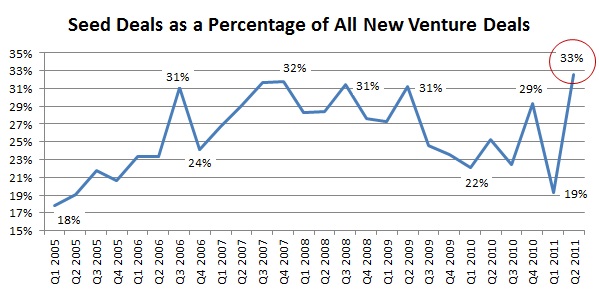
<p style="text-align: justify;"><strong>UPDATE:</strong> On his blog <a href="http://reactionwheel.blogspot.com/">Reaction Wheel</a>, Jerry Neumann shared that he has a nagging suspicion about early-stage venture capitalists: "About six months ago it seemed like they were slowing down their pace of investing while the corporates and newer super-angels were doing a lot more deals." If this is true, it surley can help explain the anomoly in Q1 the data. Since only institutional venture firms are included, the suspicion that they slowed up on seed stage deals can actually be confirmed. On the whole though, seed stage investment seemed like it was going strong because in reality, it was - just led by super angels whose deals do not make it into this data. As for if this is a warning sign, I think its too early to tell - but it is intersting that in the next quarter, relative seed stage investment by VCs hit levels last seen right before the bursting of the tech bubble.&nbsp;</p>]]></content></entry><entry><title>Relative Seed Stage VC Investment Nears All-Time High</title><category term="Seed Stage"/><category term="Venture Capital"/><category term="investment"/><id>http://www.ventureexaminer.com/venture-examiner/2011/7/30/relative-seed-stage-vc-investment-nears-all-time-high.html</id><link rel="alternate" type="text/html" href="http://www.ventureexaminer.com/venture-examiner/2011/7/30/relative-seed-stage-vc-investment-nears-all-time-high.html"/><author><name>AV</name></author><published>2011-07-31T04:44:20Z</published><updated>2011-07-31T04:44:20Z</updated><content type="html" xml:lang="en-US"><![CDATA[<p style="text-align: justify;">Last week, <a href="https://www.pwcmoneytree.com/MTPublic/ns/nav.jsp?page=notice&amp;iden=B">US venture capital investment data</a> through the second quarter of the year was made available <a href="https://www.pwcmoneytree.com/MTPublic/ns/moneytree/filesource/exhibits/11Q2MTPressRelease_Final.pdf">by the National Venture Capital Association and PwC</a>. What stood out to me most was that seed stage deals rose to account for one-third (33%) of all <em>new</em> venture capital investments in the second quarter. This was the highest such level since the first quarter of 1999 (yes, over 12 years ago!). Only three other quarters (all in 1998) come close to reaching the one-third mark (the data goes back to 1995). Essentially, we are just about at an all-time high in seed investing relative to all other venture investment. In absolute terms, $317 million was invested across 101 new seed deals. Both these figures have been eclipsed in recent history, however, looking at the relative level of investment gives us better insight as to what is happening in the venture industry at any time, regardless of its size. Also, as I have mentioned before, because most venture industry data is not consistent in terms of quality, it&rsquo;s better to look at trends rather than focus on specific numbers.</p>
<p style="text-align: center;"><img style="width: 575px;" src="http://www.ventureexaminer.com/storage/Seed%20Investment%20-%20Q2%202011.jpg?__SQUARESPACE_CACHEVERSION=1312088131826" alt="" /></p>
<p style="text-align: center;"><span style="font-size: 60%;">Data Source:&nbsp;PricewaterhouseCoopers/National Venture Capital Association MoneyTree&trade; Report, Data:&nbsp; Thomson Reuters</span></p>
<p style="text-align: justify;">The reasons for a rise in seed stage funding are seemingly pretty clear - the data helps perhaps confirm the growth and institutionalization of Super Angel/Micro VC funds as well as the recognition of the importance and benefits of seed investment by larger venture firms with more diversified strategies. &nbsp;The interesting thing about the last time seed investment hit these levels was that it was right before the bursting of the internet bubble. Perhaps a high relative level of seed investment is a leading indicator for a tech/vc bubble. I think this is a controversial topic and I won&rsquo;t stray into my thoughts too much but I think it&rsquo;s very hard to tell if we are in a tech bubble. You probably can never know for sure if there has been a bubble until it pops. &nbsp;In general, I do believe higher level of seed investment is healthy for the venture ecosystem, as long as valuations are reasonable.</p>
<p style="text-align: justify;">One other thing that stands out when looking at the data is the temporary, but sharp, drop in the relative level of seed investment in the first quarter of 2011. I can&rsquo;t help but think this was just a random anomaly, because no other stage of venture investment experienced the same volatility. I can&rsquo;t think of any convincing reason why the drop would have been so large for just the first quarter. Feel free to comment if you have any suggestions. It should be interesting to see what the data shows us for the coming quarters. I&rsquo;ll be sure to provide an update when new data is released.</p>
<p style="text-align: justify;"><strong>UPDATE:</strong>&nbsp;On his blog&nbsp;<a href="http://reactionwheel.blogspot.com/">Reaction Wheel</a>, Jerry Neumann shared that he has a nagging suspicion about early-stage venture capitalists: "About six months ago it seemed like they were slowing down their pace of investing while the corporates and newer super-angels were doing a lot more deals." If this is true, it surley can help explain the anomoly in Q1 the data. Since only institutional venture firms are included, the suspicion that they slowed up on seed stage deals can actually be confirmed. On the whole though, seed stage investment seemed like it was going strong because in reality, it was - just led by super angels whose deals do not make it into this data. As for if this is a warning sign, I think its too early to tell - but it is intersting that in the next quarter, relative seed stage investment by VCs hit levels last seen right before the bursting of the tech bubble.&nbsp;</p>
<div class="body">
<div style="text-align: center;"></div>
</div>]]></content></entry><entry><title>The MBA - Addressing Notions and Sharing My Experience</title><category term="Entrepreneurship"/><category term="MBA"/><category term="Venture Capital"/><id>http://www.ventureexaminer.com/venture-examiner/2011/7/30/the-mba-addressing-notions-and-sharing-my-experience.html</id><link rel="alternate" type="text/html" href="http://www.ventureexaminer.com/venture-examiner/2011/7/30/the-mba-addressing-notions-and-sharing-my-experience.html"/><author><name>AV</name></author><published>2011-07-30T21:08:39Z</published><updated>2011-07-30T21:08:39Z</updated><content type="html" xml:lang="en-US"><![CDATA[<p style="text-align: center;"><img src="http://www.ventureexaminer.com/storage/Kellogg.jpg?__SQUARESPACE_CACHEVERSION=1312061208609" alt="" /></p>
<p style="text-align: justify;">So I&rsquo;ve embarked on my pursuit of an MBA. To many the thought of associating an MBA with anything positive is laughable. There are countless &nbsp;high profile (and of course not so high profile) people who have come out and stated that they believe that not only is an MBA useless, but that MBA students <a href="http://www.bnet.com/blog/build-business/4-reasons-an-mba-is-bad-for-entrepreneurs/379?pg=4&amp;tag=content;drawer-container">aren&rsquo;t suited for entrepreneurship or supporting innovation </a>&nbsp;and in general <a href="http://toughmoneylove.com/2008/10/17/our-economy-needs-more-engineers-and-fewer-mba%E2%80%99s/">provide little positive societal value.</a>&nbsp;One example is Guy Kawasaki who a while back stated that <a href="http://www.forbes.com/2004/03/17/cx_gk_0317artofthestart.html">there is no value of an MBA</a> to a young person who wants to start their own company. &nbsp;The issue I have with such lines of thought is that there really isn&rsquo;t any single track for entrepreneurial success &ndash; as well as success in the venture industry or any other industry and role for that matter. People who have brought transformative ideas to life and changed the world have ranged from high school dropouts to the most well educated.</p>
<p style="text-align: justify;">MBA degrees are also often misperceived to be highly linked to Wall Street. However, the truth is that the vast majority of MBA students go on to do things that have nothing to do with Wall Street. I understand the skepticism that people have towards MBA degrees because there still seems to be this unbreakable link to the world of finance and banking. One thing I have noticed is that MBA programs have noted this perception issue and, at least from my experience, have taken major steps towards fixing their immages.&nbsp;</p>
<p style="text-align: justify;">I&rsquo;m not out to defend MBA educations &ndash; everyone is entitled to their own opinions. In fact, I should probably wait to take a fully objective look at the impact an MBA has had on me after I am done and have had a chance to see how it shapes my life. However, I do think it is worthwhile to point out the positives I have encountered early in my pursuit of an MBA. More than anything I believe you learn how to think differently. Differently in a good way &ndash; so that you&rsquo;re able to step outside of your preconceived notions or even conventional wisdom so that you can effectively approach problems and lead. I think you learn lessons that in real life would take many failures and a lot of time to learn on your own. To me, all of this to me seems useful if one wants to embark on a path to do something positive and hopefully change the world for the better, no matter how subtly.</p>
<p style="text-align: justify;"><a href="http://wadhwa.com/">Vivek Wadhwa</a>, an entrepreneur and academic <a href="http://twitter.com/#!/wadhwa/statuses/70135646546702336">has said</a> that &ldquo;an MBA isn't for everyone.&rdquo; I completely agree. Everyone needs to assess their strengths, weaknesses, and opportunities before deciding on if one is right for them. Wadhwa also adds that earning one is good &ldquo;while you plot your entrepreneurial path.&rdquo; I agree with this point as well. An MBA program seems to be a good place to build fundamental business skills and thinking. It also allows you the ability to think more freely and deeply about what the most effective path for you is. I plan to keep an open mind about my MBA education as I try to figure out the most effective path for me. I hope to share more about what I learn, particularly if my perception of the education changes. &nbsp;</p>]]></content></entry><entry><title>Venture Examiner Redux</title><id>http://www.ventureexaminer.com/venture-examiner/2011/7/29/venture-examiner-redux.html</id><link rel="alternate" type="text/html" href="http://www.ventureexaminer.com/venture-examiner/2011/7/29/venture-examiner-redux.html"/><author><name>AV</name></author><published>2011-07-29T05:09:36Z</published><updated>2011-07-29T05:09:36Z</updated><content type="html" xml:lang="en-US"><![CDATA[<p style="text-align: justify;">Venture Examiner is back online after a long hiatus. I recently started my purist of an MBA at the Kellogg School of Management after spending three years working for a venture capital and private equity fund of funds firm. Prior to that, I had worked for a leading investment consulting firm in the same space and before that at a software startup. &nbsp;A few notes before I launch into my first post in a while: I&rsquo;ve updated the about page; I&rsquo;ve added a disclaimer; I&rsquo;ve changed the layout a bit; There's a new commenting system - Disqus; In general, I&rsquo;ve tried to make the site more personal &ndash; this will be reflected in the content, my twitter feed and the addition of my Tumblr page; I&rsquo;ve also altered the theme a bit so that focus will no longer be solely on venture capital &ndash; instead I will also write about other ways of funding, supporting and fostering innovation, opportunities in the emerging markets and my experiences, &nbsp;past and present, &nbsp;as they relate to these topics. The world is changing and growing rapidly and I believe that innovative and transformative ideas play an essential role. Everyone from entrepreneurs to end investors who support innovation and transformation are important. I hope to share thoughts relevant to those across the spectrum.&nbsp;</p>]]></content></entry></feed>