Main
Subscribe to E-mail Updates:

Enter your email address:

Search Venture Examiner
Tags

Entries in investment (13)

Sunday
07Mar2010

The Venture Capital / Growth Equity Opportunity in Brazil

Apologies for the brief hiatus from posting – I was in Brazil for a good part of last month, which actually provided a great opportunity to examine first-hand the opportunity for private equity there. Why private equity and not venture capital? In almost all emerging markets, venture capitalism as it is practiced in the U.S. simply does not work for a number of reasons, including weak intellectual property laws, infrastructure and markets as well as limited innovative and entrepreneurial spirit. Private equity investment, particularly growth equity (growth capital for mature companies) is most appropriate in emerging markets. Growth equity, which involves making minority investments in mature but growing companies, trumps even buyouts in emerging markets because of issues gaining control and limited availability of leverage. I’m not close to being an expert on the Brazilian economy, but the following is some of my thoughts on the growth equity opportunity in Brazil based on a few observations.

In my travels I was able to explore second and third-tier cities and even some semi-rural areas of the country, which I think provided a better sense of the country’s potential than if I had just visited larger cities such as Rio or Sao Paulo. Compared to rural areas of fellow large emerging market (and BRIC) countries India and China, the more rural parts of Brazil seemed further developed, or more ready for development. Large infrastructure investment is not as necessary as a precursor for growth as it may be in India and China. But it is still needed, particularly in the northern part of the country which is growing faster than the south. I think the government and private investors realize this, and it was evident in the many roads and bridges under construction as I traveled through parts of the north. In many ways, investing in Brazil seemed like less risky of an endeavor than investing in India or China. There’s probably less of an upside to growth investments, but also that there’s less risk and more immediate potential, a tradeoff that is probably attractive to many investors.

Brazilian consumers seem ready for growth but I did notice that the aspiration factor was lacking, or it was at least not evident, especially when compared to Indian consumers. Examples include consumers shying away from higher quality goods even if they are priced the same, or diners shying away from nicer restaurants simply base on the aesthetics (assuming it would be too expensive). I made this observation much more in the north than in the south, which brings up another point – the country’s diverse culture. The population is not as homogenous as other emerging markets and investors will have to adjust for this, especially when it comes to investing in consumer goods and service companies.

Another thing I noticed was that there were few signs of recession or that there had even been a recession – Brazil was relatively insulated from trouble in the broader world economy. The country’s quick recovery had a lot to do with government policy (which has after many decades seems properly aligned for economic growth) but a lot of is also has to do with the fact that Brazil’s domestic growth is so resilient. It may not be as fast growing as India or China, but it’s strong and also somewhat sheltered because the country is not reliant on trade with the rest of the world, even though Brazil has been expanding international trade in recent years, particularly with the U.S., China and Europe (driven mostly by natural resource demand). Growth equity investment decoupled from the world economy provides true diversification for limited partners investing in a private equity fund - which gives Brazil a leg up on many other emerging markets.  

When it comes to private equity investment, Brazil consistently ranks behind China and India in terms of amount of capital deployed and number of deals. But in recent LP survey’s I’ve seen, interest in Brazil is growing and is often higher the level of interest in India or China. In Brazil, local pensions are a huge source of capital. They’re now allowed to invest up to 20% of assets in local private equity funds, but most only invest 1-2%, which still accounts for a little less than 20% of all commitments to brazil-focused private equity funds, according to the Emerging Markets Private Equity Association. Even though there’s currently plenty of dry private equity capital in Brazil, I’d expect to commitments to increase in the coming years. Expect investment to remain heavy in the energy/natural resources sector, but other sectors will see growth for sure.

Infrastructure investment in Brazil, both private and public, will probably see increase over the next few years, driven by the need for infrastructure improvement ahead of the 2014 World Cup and 2016 Olympic games. As I had mentioned though, the infrastructure need is not as great in Brazil as it is in other emerging countries. As such, other areas, particularly industrials, manufacturing and consumer goods and services will surpass infrastructure as a destination for private equity. What about technology and more venture-type investments? Despite what I mentioned at the onset about emerging markets not being ideal for venture investment, I actually think Brazil has promise - perhaps more near-term promise for venture capital than India and China. We’ve seen so many venture capital funds fail or pull out of India and the environment in China is too murky for venture to be attractive there. But in Brazil, the regulatory, legal (intellectual property), tax and corporate governance environment is advanced, stable and reliable enough to harbor venture investment. Furthermore, I get the sense that there is a growing entrepreneurial spirit, aided in part by government programs supporting innovation and developing technologies from universities.

There should be plenty of opportunity in the internet, and mobile sectors. Both have a lot of potential for expansion in Brazil, both from an adoption and evolution point of view. Increased broadband and mobile adoption will be a basic driver, which means me-too copies of successful internet and mobile technologies from the U.S. will do well, but also expect there to be innovation from within Brazil. Still, growth equity investment remains more attractive now (especially in the manufacturing and consumer goods/services sectors). Brazil is primed for it from many angles and it should be one of the least risky emerging markets. Investors will need to be careful they are in tune to cultural and operations nuances, which means experience is key to success, as it is in almost any emerging market. It should be interesting to monitor Brazil’s growth in the coming years and as the environment for venture capital improves, look for more innovative technologies coming out of Brazil. 

Sunday
31Jan2010

Venture Capital Overhang: Shrinking

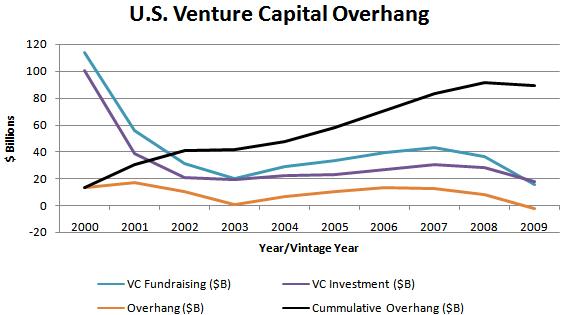
With 2009 now behind us, full final year-end venture industry data is available. There’s plenty to glean from all the fundraising, investment and exit data. Much of it tells us what we already knew or expected: fundraising and investment are down, and exits have improved, but just slightly. There’s so much you can analyze, but I’ll focus on something I’ve done in the past, which is looking at the “venture capital overhang.” This is the difference between the aggregate capital raised by venture capitalists and the amount invested. It gives us a rough idea of how much capital VCs have available for investment, sometimes referred to as “dry powder.” The chart below shows venture fundraising, investment, the difference between fundraising and investment (as the overhang) and the cumulative overhang for the last ten years.


The cumulative overhang for the last decade for the U.S. venture capital industry totals close to $90 billion, using my methodology and data from PwC, Thompson Reuters and the NVCA. As with so much of the data on the venture capital industry, the calculation is not perfect. Things like management fees and recycled capital are unaccounted for. There’s also the issue of investments made outside of the U.S.  which are not captured in the PwC MoneyTree data.  Rather than focusing on exact numbers, its more important to focus on trends and to look at the big picture.

For one, there’s clearly capital out there for venture capitalists to invest. It’s probably becoming more concentrated across a fewer number of firms - as I mentioned in my last post, good firms will continue to be able to raise capital. The overhang number is down from my previous calculation earlier this year, which signalz to that capital will be a bit scarcer.  Going forward, we should see more years like 2009 and 2003 where the levels of investment and fundraising have less of a gap and less of an overhang is created. Now, you don’t want things going in the other direction, where we have more capital invested than raised because that would of course be unsustainable. But then some would also argue that the huge levels of overhang amassed in years past were also unsustainable, which is probably true.

There needs to be certain level of reasonability maintained in the industry and less overhang will force venture capital firms to be more prudent in deploying capital. This doesn’t mean, however, that great new ideas won’t get funded, because VCs clearly have plenty of dry powder. If anything we’ll see more early / seed stage deals which not only require less capital, but have more potential upside and also bring the industry back closer to its roots of more risk taking. 

Sunday
27Dec2009

Drawing From Y-Combinator - A More Perfect Crowdsourced Venture Fund

I've written a few times now about the idea of a crowdsourced venture capital fund - where there would be a large number of small investors, each playing a role in the fund's investment decisions. It’s my belief that as the venture industry evolves, the disconnect that exists between investors, venture capitalists, entrepreneurs, and the tech community can be bridged well through such a fund. If you'd like some more background on what my ideas for a crowdsourced venture fund are you find it here, and here.

 I got thinking about a crowdsourced venture fund again after reading some more about the great stuff Y Combinator does. Y Combinator provides seed funding for startups, but money is just a small part of what they bring - typical investments are less than $20,000. Instead, where Y Combinator really provides value is in their work with the startups they fund. They provide hands-on guidance to help startups become successful, including forming the company, legal issues, developing the product(s), managing the company's growth, and even finding future funding. In an age where the cost of starting an internet company has gotten pretty low, Y Combinator, which has helped spawn great companies such as Disqus, Loopt, Scribd, Xobni, and Reddit, provides something more valuable through its expertise and connections. It got me thinking that a crowdsourced venture fund would need to be able to do something similar.

A crowdsourced venture fund would be best suited for making tech investments; particularly early-stage tech investments where the backing of a crowd (in this case the LP base as well) could help propel portfolio companies. You would also be able to draw from the wisdom of the crowd to help with any problems faced by the startups invested in. Here, you have an instant network, as long as the LP base remains on the tech-savvy side, which you would expect. But what about the nuts and bolts of a company and nurturing it properly early in its life? The truth is that most traditional venture capitalists don't do much there as you would think, which makes YCombinator special. In a crowdsourced fund you would ideally want Y Combinator-type VCs armed with their own connections which, along with input and backing from the crowd, would really create an ideal situation. You would be able to help entrepreneurs effectively through a variety of issues by drawing from the crowd, only having to make sure that the crowd is sufficiently engaged to want to lend support. Part of this is achieved through their investment into the fund itself. Part of it is also making them involved in the investment process.

What would a crowdsourced fund do with a very large pool of capital? It would be able to do what Y Combinator can't do: continue to fund the companies at later stages. Instead of having other venture firms come in for a series A or B round, ownership could be maintained in the companies as they grow. Of course you could always push for a larger ownership with the seed funding as well, but you have to be careful there as you want the entrepreneurs to be motivated with significant interest in their companies.

And what about the vetting investments? Y Combinator has an application process for companies, but for a crowdsourced fund, you would probably want a combination of companies applying for backing as well as the fund's VCs going out and sourcing investments in a traditional manner. Both sources of dealflow would be pooled and, as I've mentioned before, the crowd, or LP base, would be able to vote on the most promising companies, which the VCs would then use as input in making their final decisions. The reason you wouldn't leave it up purely to a vote is that you need to protect the confidentiality of potential investment and so voters would not have complete information when making decisions. You would also use the wisdom of the crowd by voting/collaborating on solutions to problems companies face that can't easily be solved by the VCs and would benefit from having input from the crowd. While the crowd, or LPs, wouldn't be compensated for their participation, they all have their investment in the funds at stake as a motivator.

The thought of a crowdsourced venture fund is definitely idyllic, and maybe even more so if you want to try to do some of the things Y Combinator does, but as capital starts to take a back seat to the other things venture funding should provide, it’s a model that seems to make more and more sense.

Previous posts on Crowdsourcing Venture:

Crowdsourcing Venture

Another Take on Crowdsourcing Venture

Sunday
22Nov2009

Observing Larger Trends in Healthcare VC

This year, venture investment into the healthcare sector surpassed investment in the traditionally heavyweight information technology sector for the first time in over a decade. This trend has been well covered and there are plenty of reasons as to why venture capitalists have shifted focus to healthcare (less cyclical, lower valuations, less fundamental change, etc).  What’s interesting about the trend is that there’s been a historical correlation between difficult economic environments and the relative level of healthcare venture capital investing.

Here’s a look at healthcare investment as a percentage of all venture capital investment over the past 10 years: 


What you notice, besides the clear increase in relative healthcare investment over the past decade, is two dramatic spikes: The first in the years following the tech bubble – which is partly the result of VCs shying away from the tech sector while those investing in healthcare maintained their investment pace. Plus, many tech VCs looked for safety in the relative less volatile healthcare sector. The second spike is more recent - starting last year as the recession took hold and what can be considered a small venture bubble burst.  The reasons for this spike are similar as the previous, and as with the previous spike, the absolute dollars invested in the sector have still declined.

What’s also interesting about the two spikes is that they are predicated by a short decline in relative healthcare investment, which makes you wonder - is the relative level of healthcare investment perhaps a leading indicator for venture capital bubbles? It appears so. During bubbles, VCs are more apt to pour cash into what can be more lucrative, but also more risky technology investments.

This recent spike, where healthcare investment has reached almost 40% of all venture investment, is probably just that - a spike. Unlike earlier this decade, the levels of healthcare investment should come back down again as clean technology and IT investment pick up. But the case for healthcare investment remains and we’ll probably see it remain around 30% of venture investment going forward. Demand will continue to be driven by an aging population, continued technological progress, declined pharma productivity and government programs such as those pushing healthcare IT and increased access to healthcare.

Data Source: PricewaterhouseCoopers/National Venture Capital Association MoneyTree™ Report, Data:  Thomson Reuters

Tuesday
27Oct2009

VC Shift To Seed Stage Investing Is For Real

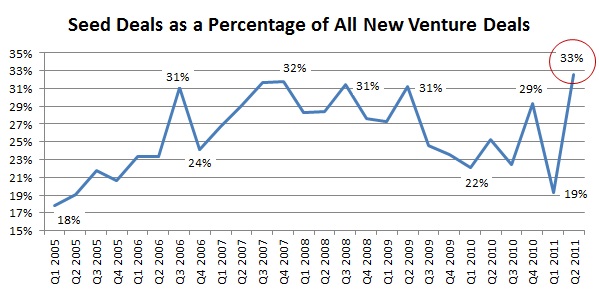
Third quarter venture capital investment data was made available last week which prompted me to re-examine the data I looked at in my previous post on the recent spike in seed stage investing by venture capitalists. More specifically, I wanted to see if the data trend held true to what seems to be going on anecdotally - are venture capitalists really dramatically shifting their focus to early and seed stage deals? The answer still seems to be a resounding yes. The chart below is a more detailed look at the percentage of all initial investments allocated to seed stage deals by venture capitalists by quarter since the post-bubble period (2001-2003).

You’ll notice the spike in the second quarter of this year, but the third quarter still represents the highest level of relative seed investment since the second quarter of 2005. Furthermore the data trend still clearly shows that venture capitalists have indeed continued to shift more of their focus to seed stage investing. Why? Well, as I’ve covered before, it’s a reflection of a few factors:

  • Lack of syndicate partners for later stage deals
  • Lack of capital or adequate reserves for later stage deals
  • Skepticism around the medium term prospect for exit (IPO and M&A markets)
  • The realization that more risk needs to be taken to achieve desired returns
  • A rise in the number of quality “venture-backable” start-ups and entrepreneurs (partially a product of the state of the US economy)

Data Source: NVCA PricewaterhouseCoopers/National Venture Capital Association.